Thursday, October 9, 2014

Nobel Prize in Physics Rewarded for Invention of blue LEDs


The Nobel Prize for physics of 2014 has been rewarded to a group of Japanese and American scientists for an invention that took place in the early 1990s. The scientists are Isamu Akasaki, Hiroshi Amano, and Shuji Nakamura. These three are responsible for inventing the blue LED ( light-emitting iodide) which changed the world by allowing us to create white LED, which may seems simple to us now but had not been previously achieved with ease.


The three scientists are now sharing the prize of 8 million kronor ($1.24M) and have been praised by the Nobel Prize committee, where a professor mentioned that "these uses are what would make Alfred Nobel happy". It has also been brought to attention that unlike many Nobel Prizes in physics, this one can actually be usefully applied today.

Although red and blue LEDs were already well known in the 1990s, many scientists and businesses had tried and failed to create a blue one. Being necessary for white LEDs, its invention allowed technology to come up with some major advancements such as LED lamps, which are more energy efficient, long-lasting and hence better for the environment. As for day to day uses, blue LEDs can be found in Blu-ray players and LCD powered backlit smartphones—something most of us don't imagine living without.

Tuesday, October 7, 2014

Sensor that tracks your health

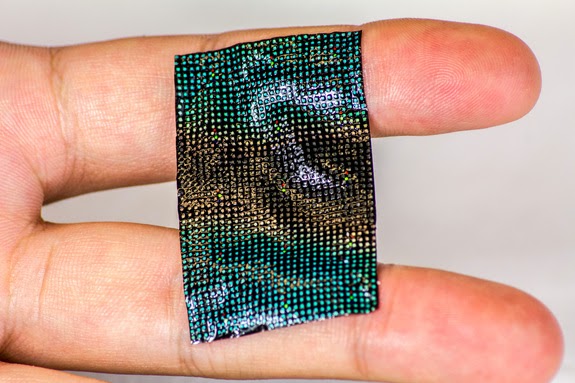
Researchers at the University in Illinois and the University of Illinois at Urbana-Champaign have built a patch made of flexible electronics that sticks to human skin and could calculate body temperature, monitor blood circulation and even tell you when you need to wear sunscreen.

It´s made of plastic and thousands of tiny liquid crystals, which change color in response to body heat, and since there are around 3,600 of them, they can actually depict a heat map.

The device could reveal problems such as poor circulation in the extremities, which can be a symptom of diabetes, or an early sign of heart disease. It could also be used to detect some types of injuries in the skin and tissue just underneath the sensor; and all data would be presented in a very useable format. A device like this that could be attached to a person´s skin, and since it is so unobtrusive that people forget they are wearing it, it would be a great help to physicians, researchers say.

The device is so small that it doesn't need a battery. There's a wireless and flexible power system on the back, which can run on power from a remote source. The most important part is that the cost of the device should be relatively low, since the sensor doesn't use any exotic materials or parts. We would be talking about a few dollars.

to view the full article go to:  http://www.livescience.com/48109-flexible-skin-sensor-track-health.html

Sunday, September 28, 2014

Surprising lake bigger than West Virginia inside the Greenland ice

Unlikely liquid water may hold clues to the effects of Global Warming

An ice core segment with water taken from the underground aquifer discovered in Greenland.

A vast aquifer lake lies trapped under southeastern Greenland. This discovery may help the scientific community to find reasons for the climate´s changing. The fact that there exists an aquifer 27,000 square miles under the Greenland region is a matter of scientific interest.

Lora Koening of NASA´s Goddard Space Flight Center said it is a magnificent discovery, because even thought water percolates down the surface when the ice melts, the water did not refreeze. Koening and a group of colleges went to Greenland to take core samples, and to prove if there exists life in Greenland´s aquifer.

The fact that melt water can remain in liquid form, provides information about how long it takes the water to get to the sea, and can determine how much and how fast the sea level will rise, which is of vital importance to the communities who live on the coasts.

Thursday, September 25, 2014

Computers 1,000 times faster? Quick-change materials break silicon speed limit for computers


Faster, smaller, greener computers, with the processing power of over 1000 current computers. This technology can me made possible with new Phase Changing Materials!

The current silicon based microchips would be replaced with 'Phase-change materials' (PCMs). PCMs are capable of switching between different electrical states. One state is a crystalline conductor while the other a glassy insulator. It does this in under a Billionth of a second through small electrical shocks!

The difference between silicon based chips and PCMs is where logical operations and memory is located. In silicon based chips memory and operations are located separately while in the PCM chips they are located in the same spot. This means that Dynamic Random Access Memory can eventually be removed!


To View the full article please go to: 
http://www.sciencedaily.com/releases/2014/09/140919110639.htm

The Moving stones of Death Valley


    The moving stone's of Death Valley,CA


        Everyone knows that rocks can not move by themselves, yet there is one mystery, that has had scientists puzzled for decades. At Death Valley's national park, there lies a dried lake, also known as the Racetrack Playa. It has been said that many heavy boulders, some weighing up to 300 kg, have been found with long trails behind them, cutting a furrow in the sediment, as if they had moved. No one has actually seen the stones move, yet they have been said to be moving around a lot. 

       Their discovery was first made in the 1940's, and ever since then, many geologists have thought up many theories as to how or why the would have moved. Many of them have been proved wrong, and only recently have they been ably to get an idea of what might be causing this. Scientists believe that ice is the cause to this famous mystery.

    They have been able to gather evidence, using GPS devices and cameras. There is a thin layer of ice in which develops on the dirt, in which causes the rocks to move, yet the process is so slow, it would be hard for the human eye to capture it. This is why it still seems so hard to believe.


  For more information, visit:

http://arstechnica.com/science/2014/09/death-valleys-famous-moving-stones-caught-in-the-act/


Thursday, September 18, 2014

Fukushima Radiation: Our days of eating fish are over?


Following Japan’s devastating 2011 earthquake and tsunami, fear spread about risks of leaked radiation from the Fukushima nuclear power plant for the planet and the potential impacts on our complex marine food web.

It’s the largest single contribution of radiation to the marine environment ever observed. With 300 tons of contaminated water pouring into the sea every day, Japan’s government acknowledged the urgency of the situation.

It took 3 years from the time of the incident (2011) for the radiation plume to reach the West Coast, which is this year. Recent testing of migratory fish, including samples collected from Pacific blue fin tuna caught off the California coast, assessed radiation levels and potential effects on marine food webs far away from Japan, although they are below the level of being harmful for humans.

Any amount of leaked radiation is harmful to the planet and the health of all species, including humans. That doesn't mean it’s unsafe to eat all fish caught on the Pacific West Coast, but we should keep in mind that there are always long-term health risks.

Next, German Scientists have calculated the dispersion of radiation in the Pacific Ocean. Check the counter of the days in the top right:


For more information, Check this: 

  • http://ecowatch.com/2013/10/09/fukushima-radiation-safe-to-eat-fish/


Thursday, September 11, 2014

Scientists Remotely Activate Genetic Target To Slow Aging Process

A team of researchers led by David Walker of UCLA have discovered the a gene that slows down the process of ageing. The AMPK enzyme found in all eukaryotic organisms assists in regulating the energy levels of cells and has been found to increase ATP production through fatty acid metabolism and increased glucose uptake. Through experiments with AMPK in fruit flies they have seen outstanding results. It is estimated that if it were to be used on humans, our life expectancy would increase from 80 years to 104; about 30% more. Our lives wouldn’t just be longer, but our life quality would be improved as well by being healthier for longer.

This revolutionary method of stopping ageing can prevent many diseases like: cancer, stroke, cardiovascular diseases and even diabetes. This may take many years, but scientist believe a healthier and slower ageing process is possible. The gene works effectively as it clears away cellular waste from your brain. If some dead cells are kept inside, it can lead to many diseases. The problem is that this is not very stable because a lot of AMPK can cause other problems to rise in humans. Research is ongoing but Dr Walker and his team are confident that this breakthrough could be brought to the patients in the next few years.
For more information please visit full article: http://www.iflscience.com/health-and-medicine/scientists-remotely-activate-genetic-target-slow-aging-process
(Ernie & Stefano)